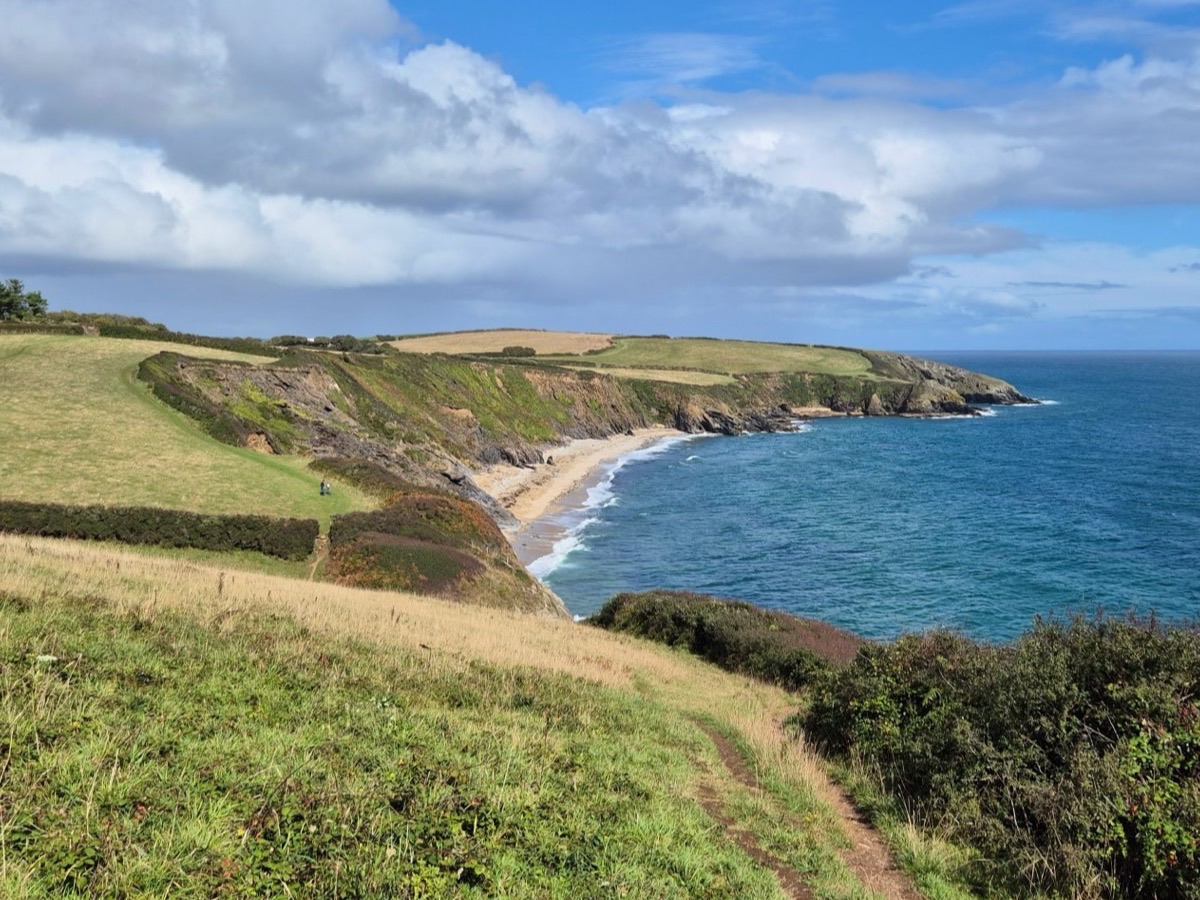
A coastal path is never finished. Erosion, rain and feet rewrite it every winter, and the walk is better for it.
The path starts at the end of the village street, between two gardens, and climbs the field behind the sea wall. It is not a grand path. It is a strip of worn grass, a farm gate, a line of rabbit runs through the hedge. In October the grass is wet to the knee and the ground beneath it is soft. I pull my boots on at the gate and go up slowly.
A path that changes its mind
Every winter the path takes a new line. The cliff at the far end loses a metre or two, and the county puts a diversion across the field. The old line stays visible for a while, a pale scar running out to nothing. Then the grass covers it and the scar becomes part of the slope.
Walkers who come once a year complain about the diversions. I like them. They are evidence that the coast is alive and that the path is honest about it. A route that never moves is a route that has stopped paying attention.
The climb, and what it opens
At the top of the field the hedge ends and the whole estuary appears at once: the creek, the mud, the far bank, the sea. On a clear day there is a boat on the horizon and a line of white surf beyond the bar. On a wet day there is only grey, and the grey is better. The path turns north along the cliff edge and the village drops out of sight behind the rise.
This is the part of the walk I come for. Not the view exactly, but the smallness of the path in it. The fence posts lean; the grass thins; the drop on the left is sudden and grassy and ends in a beach no one visits. A skylark goes up from somewhere in front and sings until it is a speck.
Gates, mud and other people
There are four gates on this stretch. Three are metal and one is wooden and swollen and needs a shoulder. Close every one behind you. The field holds sheep in winter, and a dog that has never seen a sheep is a dog that will chase one. Mine is on the lead from the first gate to the last.
Other people pass in ones and twos: a runner with muddy calves, a couple with binoculars, a man who says good morning to the grass. There is room for all of us. The path is wide enough for two abreast and the etiquette is simple: give way on the seaward side, keep the dog in, say hello.
The far end
The path drops into a valley with a stream and a plank bridge, then climbs again towards the headland. I usually stop at the bridge. Beyond it the walk becomes a different one, longer, with a steeper climb and a beach at the end, and I like knowing it is there.
The estuary below has filled while I have been walking. The creek is a silver line and the mud is going under. By the time I turn back the tide will have covered the lower path and the birds will have moved up to the wall. The walk home is into the wind and takes less time than the walk out.
Why the edge matters
A coastal path is a public good in the plainest sense: a way to reach the coast without owning any of it. It is also a narrow thing, easily lost to a fallen fence or a landowner's patience. Walk it, close the gates, keep to the line, and it stays open for the next person.
At the gate by the village I stop and scrape the mud off my boots. The path behind me is a wet line in the grass, already closing over. Tomorrow it will be there again, a little different, and that is exactly right.