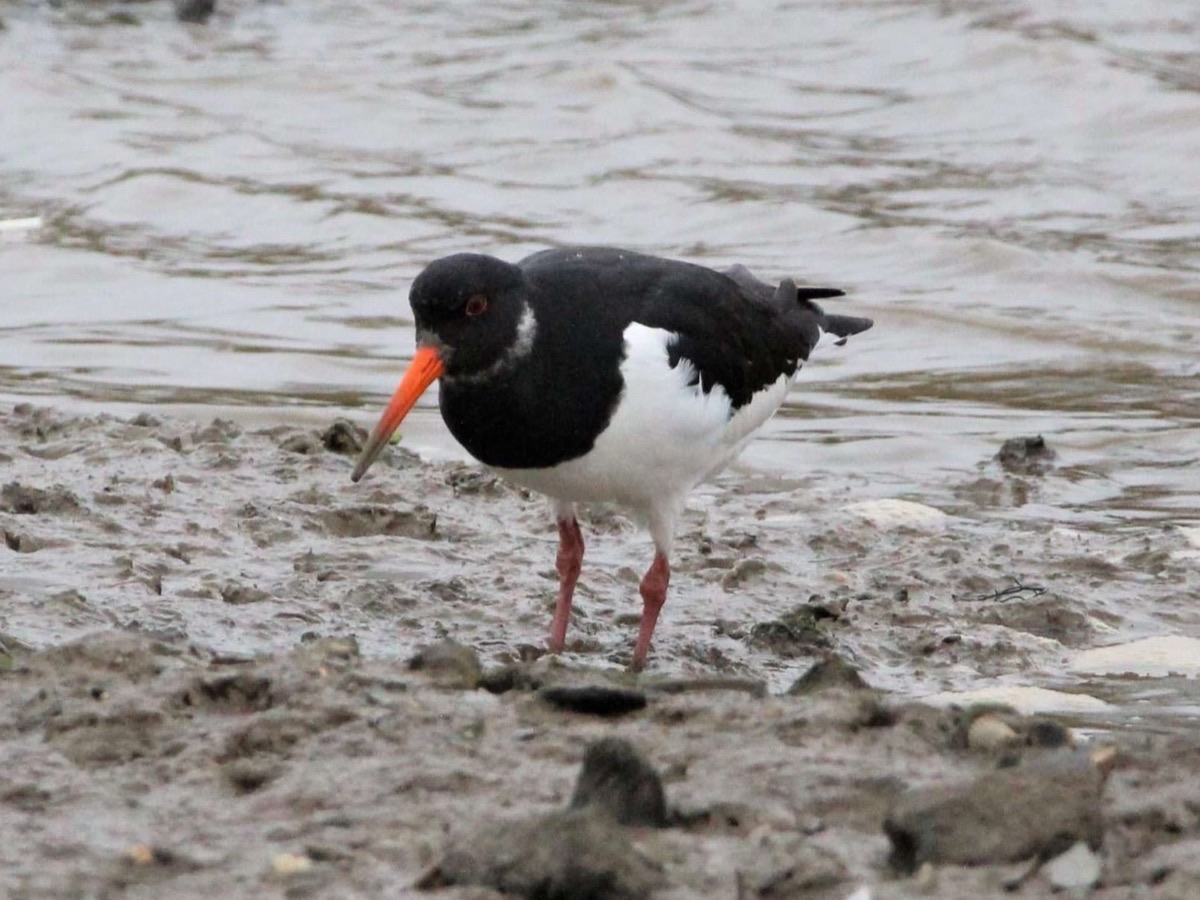
A cold estuary in January is not a hardship for a wader. It is a full larder and a few hours of hard work.
The first hard frost turns the estuary into a grey sketch. Mud stiff as a board, creek edges furred with rime, the sea wall treacherous where the grass has frozen flat. Waders stand in it without any sign of discomfort. An oystercatcher on one leg, bill tucked, could be mistaken for a bird enduring something. It is not enduring. It is waiting for the tide to move.
Winter is the season of numbers
More waders come to this coast in winter than at any other time. Some are from the far north, some from the continent, some from breeding grounds in the same country. The estuary is a warm, ice-free larder when inland waters are locked. Wintering birds gather here in hundreds, not the scattered pairs of spring. Sitting on the wall before dawn in December, the sound of curlew calls carries over the water from every direction.
People who only visit in summer see a quiet marsh and pity the birds that stay. Summer is the lean time, not winter. In summer the birds are on the tundra or the hill, or hiding their nests in a rush field. In winter they have the estuary to themselves and the work is straightforward. The pity is better spent on the breeding grounds, which are shrinking.
Hard weather, real losses
That is not to say cold is harmless. A long freeze seals the mud and the birds cannot feed. A fortnight of it can kill a lot of dunlin and grey plover, and the roosts thin in front of me. The estuary gives what it can, but a solid week of ice takes more than it gives. When the thaw comes, the survivors feed with a frantic, single-minded energy.
Brent geese arrive with the same cold. They pull at the marsh grass and the field edges and look, to a casual eye, as if they have eaten everything. They have eaten a little. The marsh regrows. The geese leave in spring, fatter, and the green comes back.
Keep the roosts undisturbed
On the highest tides the waders roost on the saltmarsh itself, standing in the grass above the water. This is when they are most vulnerable. A dog off the lead can put up four hundred birds at once, and each flight costs energy they cannot easily spare. In cold weather that energy is everything. From October to March I keep my dog to the path and the wall, and the telescope does the rest.
There is no need to get close. A wader's world is the few metres around its bill. Watch from a distance and you will see feeding, preening, squabbling, resting: the whole ordinary business of living. Walk into the middle of it and you see only the backs of birds leaving.
The oystercatcher's winter
The oystercatcher in front of me is one of the commonest birds here and one of the least understood by visitors. It is a specialist of the mussel beds, the cockle sand, the gravel above the strandline. The orange bill can open a mussel or hammer a limpet; the same bird will also probe a wet field for worms. In winter it roosts in loose groups along the wall and waits out the low water, then moves down to feed with the rest.
It is not pretty in the way a songbird is pretty. It is compact, noisy, and built for work. When it lifts off, the black-and-white wings open like a pair of shears. There is no hardship in the picture, only purpose.
Go out in the cold
The estuary in winter asks for a good coat and a willingness to stand still. In return it gives a version of itself that summer never shows: numbers, movement, the raw edge of the tide. The birds stay out in it because they have to. We go out because we can, and because a curlew calling across a frozen creek is worth the frozen fingers.