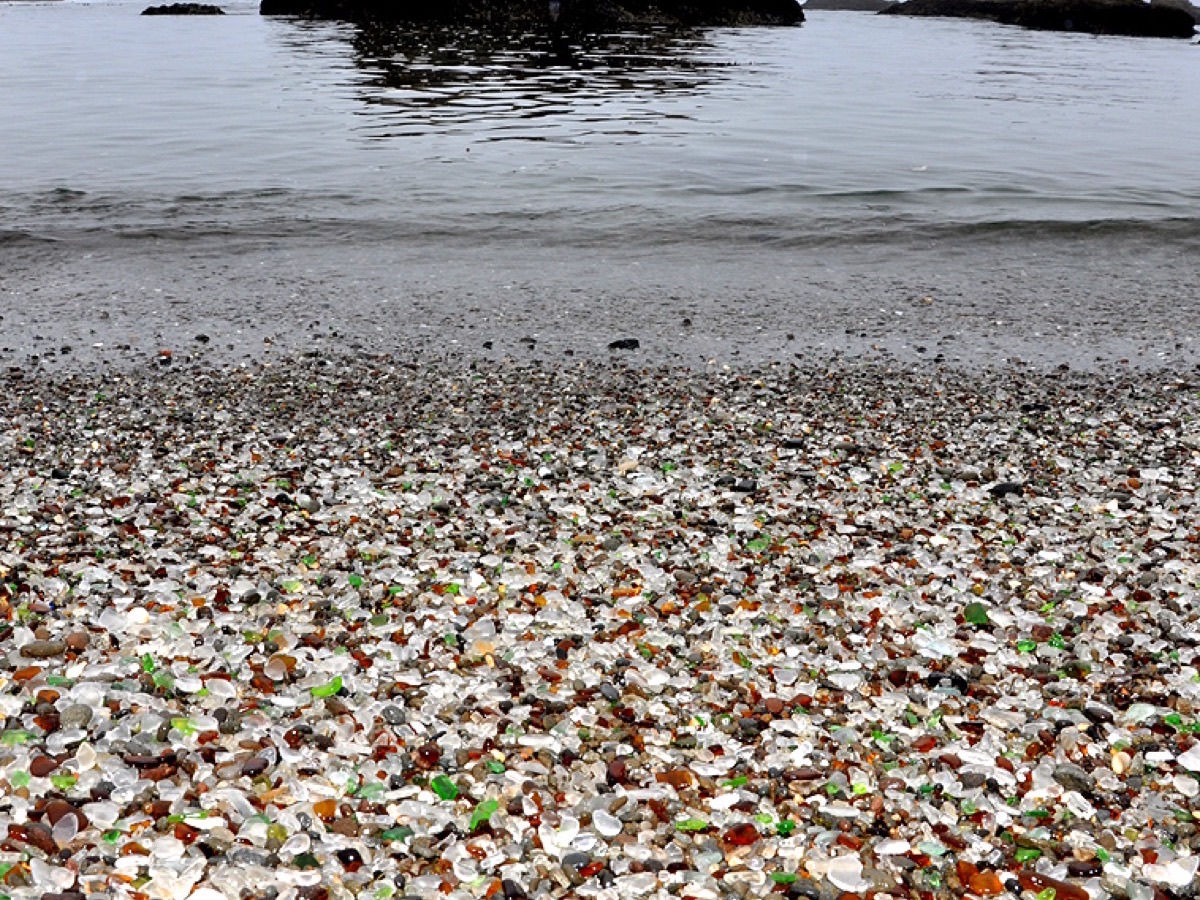
Sea glass is a lesson in patience, and in the difference between a thing worth keeping and a thing worth leaving.
After a big tide the strandline is a long stripe of weed, twigs, bottle tops, cuttlebone and, if I am lucky, glass. Not much of it. A few pieces, most of them small, all of them worn to a frost. The sea has taken a broken bottle and spent twenty years making a pebble out of it. I pick one up, turn it over, and put it back down.
Why it is where it is
Sea glass gathers at the top of the beach because that is where the waves let go. It travels in the same drift as the weed and the cuttlebone, and after a storm it can turn up in quantities that surprise people who have walked the same beach all summer. The next tide may take it all away. There is no hoard to find, only today's deposit.
Every piece has a source, though rarely one I can name. Most of the green was a wine bottle or a beer bottle. Brown was almost certainly a bottle too, thick and dark and hard to see among the weed. Clear was a jar, a window, a tumbler. The rare blue was medicine or ink or a bottle of something that no longer exists. Red and yellow turn up often enough to keep me looking and seldom enough to keep me interested.
The difference between glass and glass
Not every piece on the strandline is sea glass. Some is freshly broken, with sharp edges and a bright, printed curve still readable. Some is bottle-bottom thick, with the outer skin still glassy on one face. The good pieces are uniformly matte, their edges soft, their surface showing the small crescents of many collisions. Hold one to the light: if it glows, it is probably clean enough to keep; if it is dead and flat, leave it for someone else.
Colour is the collector's obsession and a distraction. The first piece I ever kept was a common green, and I kept it because its shape was perfect, a smooth oval no bigger than a thumbnail. A rare colour with a bad break is still a bad piece.
Taking less
There is a small industry in sea glass now, and beaches that were once generous are picked clean by people with buckets and an eye on the market. I limit myself to a jacket pocket's worth. Seven or eight pieces is a good day. Anything more and the sorting becomes a chore.
The ones I keep sit in a jar on the kitchen windowsill until winter. Then I take them out, choose two or three, and put the rest back on the beach where they came from. It feels like a fair exchange. The sea made them; it can have them again.
The other things on the strandline
Sea glass is only the showiest part of the deposit. Cuttlebone, whelk shells, mermaid's purses, a length of rope worn to a soft grey braid, the plastic cotton buds that never quite disappear. The strandline is the estuary's receipt, an inventory of everything upstream and offshore. Read it and you learn about the coast as much as the water.
At the top of the beach I stop and look back. The line of weed and glass runs on for a hundred metres and then breaks. By evening the tide will have rearranged it. The piece I left behind will be somewhere else, or gone. That is the point of it, really: nothing here is mine to keep for long.