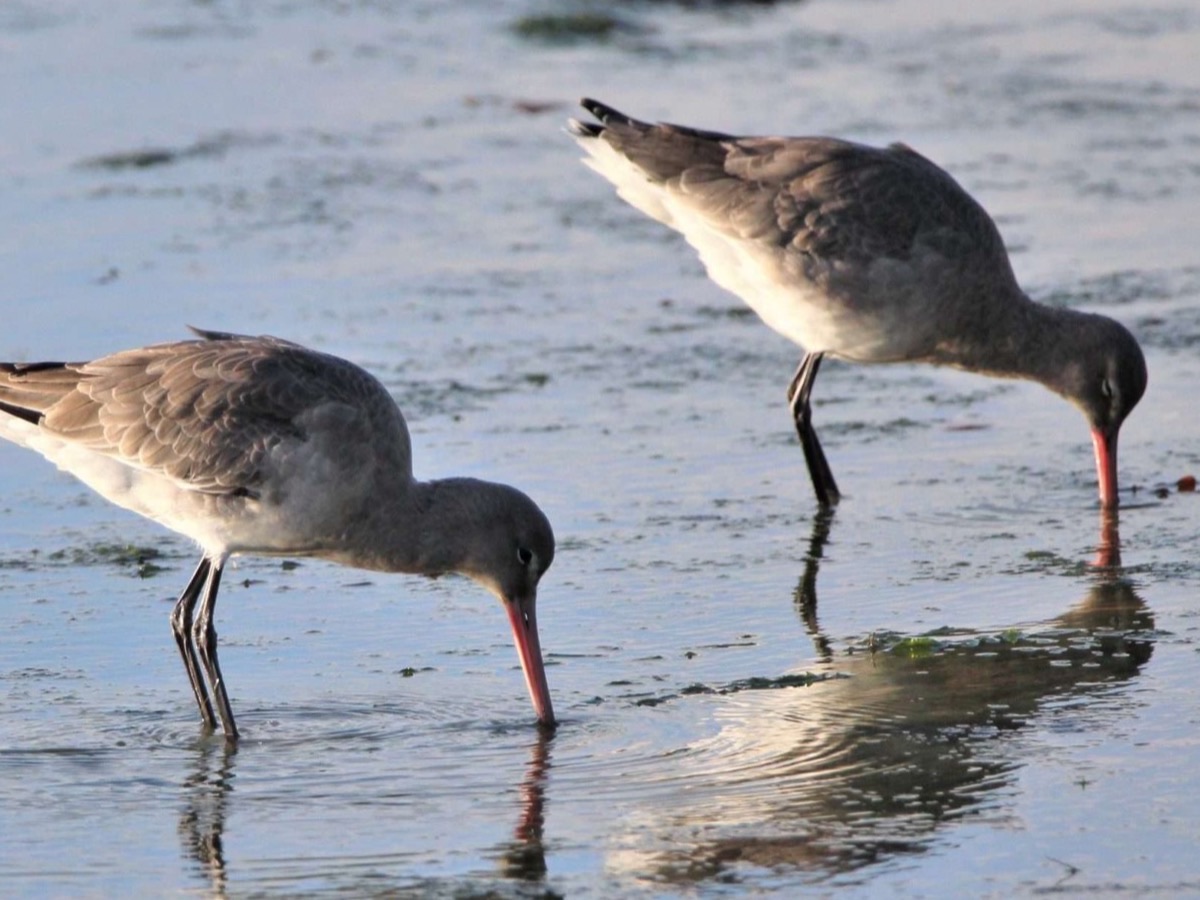
The falling tide pulls the estuary into shape, and the waders arrive to work the mud it leaves.
At half-tide the estuary looks like a different place. The channel that runs past the sea wall narrows to a brown ribbon, then to a wet shine, then to nothing. What is left is mud, and the birds come to it before the water has properly gone. Two black-tailed godwits land below the wall at ten past six and begin feeding with their bills deep in the ooze. They do not look up. The tide has given them a few hours of work and they intend to use them.
The mud is a larder, not a wasteland
From the wall, the estuary floor appears empty. Close up it is crowded: ragworms, lugworms, small bivalves, shrimps, the larvae of flies I cannot name. Each bird works a different part of it. Godwits probe deep; dunlin stitch the surface; ringed plovers pick at the edge of the water where the mud is firmest. A shelduck shepherds her ducklings along the channel and lets the smaller birds keep the shallows.
People call this mud dull. It is the reason any of it exists. Take a handful from a spade's depth and it smells of sulphur and rot and life. Take the mud away, or carpet the estuary with concrete, and the birds have nowhere to feed. It is easy to protect a reedbed because it is handsome. The mud needs a harder kind of affection.
Watch from the wall, not the edge
The sea wall gives me height and distance and a dry place to stand. It also keeps me from pressing into the estuary itself, which is what the birds notice first. Nine metres is too near. Fifteen metres is better. With a telescope I can count the rings on a godwit's leg from the top of the bank without disturbing anything at all.
Early May is a migration month and the numbers shift daily. Monday brings forty dunlin. Tuesday brings six. A flock of ringed plovers appears for an hour and is gone before the tide turns. The estuary is not a collection; it is a corridor. The birds are using the whole coast, and this stretch of mud happens to be on the way.
Names help, but seeing comes first
I learnt the names slowly, mostly from people who had watched longer than I had. Godwit, redshank, dunlin, grey plover, curlew. Names are useful because they let me write things down and compare one spring with the next. They also make it easier to say what is changing: fewer dunlin here, more grey plover there, a roost that has shifted fifty metres downriver.
But the first pleasure was not knowing. It was sitting still on a cold wall at dawn and watching an unlabelled bird make a living out of a place I thought I knew. The bird did not need my name. The mud was enough.
When the water returns
At eleven the tide comes back through the creek, spreading fast over the bank. The godwits lift together, straighten out over the channel, and go. By midday the estuary is silver and the wall is the only solid line in it. Tomorrow the table says a later tide, and the birds will have a slightly different morning.
I walk home with mud on my boots and the smell of the marsh in my coat. It is a good smell. It means the place is still working, and the godwits have somewhere to stop.